

What is SEO?
SEO (Search Engine Optimization) is the practice of optimising your website — structure, content, and external signals — to rank higher in search engines like Google, driving organic traffic and qualified leads.
- Core goal: Rank high on Google, earn clicks, increase visibility, and convert visitors.
- Key levers: Keyword optimisation, content depth, technical SEO (speed, crawlability, indexing), backlinks, and user experience.
What is GEO?
GEO (Generative Engine Optimization) is the optimisation of content for AI-powered search engines — ChatGPT, Perplexity, Google AI Overviews, Gemini, and more. Instead of ranking in a list of blue links, GEO aims to be cited or recommended inside the AI-generated answer.
- Core goal: Be the brand AI mentions, increase brand visibility, and become the “default recommendation”.
- Key levers: Semantic clarity, entity optimisation, structured content (FAQ, definitions, comparisons), authoritativeness, and AI-readable structures.
Similarities Between SEO and GEO
Both rest on the same foundational principles of quality and trust:
High-Quality Content
Both Google and AI favour clear, structured, and authoritative content that directly answers user intent.
Structured Information
Headers (H1–H3), lists, FAQs, and step-by-step guides help both search engines and generative AI parse meaning.
E-E-A-T
Experience, Expertise, Authoritativeness, and Trustworthiness are central to ranking in both worlds.
Semantic Understanding
Modern algorithms understand topics, intent, and relationships — not just keywords.
Key Differences Between SEO and GEO
Traffic Source
SEO: clicks from Google results.
GEO: citations / mentions within AI replies.
Display
SEO: 10 blue links.
GEO: direct answer, often with 1-3 brand references.
Primary Goal
SEO: rank high and get clicks.
GEO: be cited, become the “default” AI suggestion.
Content Focus
SEO: keywords, backlinks, page weight.
GEO: semantic clarity, entity structure, AI parsability.
SEO + GEO: The Overlap Mindset
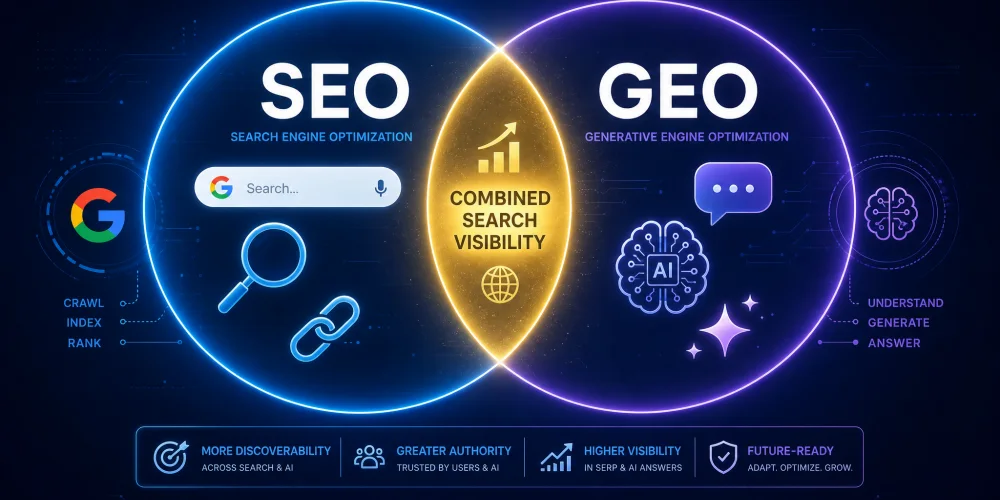
They are not an “either/or” — they are a layered system:
- SEO secures your Google traffic.
- GEO secures your AI visibility.
- Together they form a complete search visibility system.
How to Do SEO (5-Step Framework)
Key Content = flesh · Backlinks = skeleton · Internal links = blood · Architecture = foundation · Keywords = facial features · Brand trust = soul.
How to Do GEO (3-Step Framework)
Use FAQ, How-to, What-is structures. Add proprietary insights: real cases, personal experience, unique judgement. Show author credentials (E-E-A-T).
– Schema markup (FAQPage, Product, Article).
– PageSpeed ≥ 90 (mobile and desktop).
– robots.txt: allow GPTBot, ClaudeBot, and other AI crawlers.
Align content with LinkedIn, Reddit, and industry forums. Earn citations from authoritative media — AI treats them as trust signals.
Measure Test: Search your keywords in ChatGPT, Gemini, or Perplexity. If your brand appears, your GEO is working.
How to Combine SEO and GEO (Business Strategy)
- 1. Build baseline traffic with SEO (Google rankings).
- 2. Expand AI exposure with GEO (citations in ChatGPT).
- 3. Use structured content formats that serve both: FAQs, guides, comparison posts, and how-to articles.
- 4. Build topical authority — publish consistently around a core theme (e.g., WordPress, Google Ads, AI search).
SEO vs GEO at a Glance
Final verdict: SEO + GEO = complete search visibility.
Frequently Asked Questions