
1. Homepage
The homepage is the starting point for most visitors, but it should not try to explain everything about your company. Its main purpose is to communicate your positioning quickly and guide visitors toward the information they are looking for.
A strong B2B homepage should clearly explain what you manufacture, who you serve, and why customers should consider working with you. For example, a company selling industrial filtration equipment might position itself around filtration solutions for specific industries rather than simply saying that it is a “professional manufacturer.”
The homepage should introduce your main product categories, important applications, manufacturing capabilities, certifications, customer experience, and selected case studies. It should also include clear calls to action such as Request a Quote, Send an Inquiry, or Talk to an Expert.
From an SEO perspective, the homepage should also establish the overall topic of the business. It can target broad terms related to the company’s products and services while more specific keywords are handled by dedicated product, industry, and solution pages.
2. Product Category Pages
For manufacturers, product category pages are one of the most important parts of the website structure. They help buyers understand the overall product range before they move into individual products.
A good product category page should briefly explain the category, introduce the main products, and help visitors choose the right option. It can also include information about common applications, materials, configurations, or technical characteristics.
For example, an industrial manufacturer might organize its products into categories such as Filtration Systems, Separation Equipment, Mixing Equipment, and Industrial Components. Each category can then link to individual product pages.
This structure is useful for users because it makes navigation easier, but it also creates a strong foundation for B2B website SEO. Search engines can understand the relationship between the company, its product categories, and individual products more clearly.
3. Individual Product Pages
Individual product pages are often where B2B buyers make their first serious evaluation of a supplier. Someone searching Google for a specific product may land directly on one of these pages without ever seeing your homepage.
For this reason, every important product should have a dedicated and detailed page. A strong B2B product page should explain what the product is, how it works, what problems it solves, where it is used, and what options are available.
Depending on the product, you may also need to provide technical specifications, dimensions, materials, performance data, certifications, customization options, production capabilities, downloadable documents, product images, videos, and frequently asked questions.
Price information may not always be appropriate for B2B manufacturers. In many cases, pricing depends on specifications, order volume, customization, shipping destination, or project requirements. Instead of forcing a fixed price onto the page, it can be more effective to provide a clear Request a Quote or Get Pricing option.
Well-developed product pages also create opportunities to rank for long-tail commercial keywords. A page targeting a specific product and application can attract visitors who already have a clear purchasing requirement.
4. Industries Pages
Not every buyer thinks about your products in the same way. Many B2B customers start with their industry or application rather than a specific product name.
That is why industry pages can be extremely valuable for manufacturers. Instead of simply saying that you sell a particular product, an industry page explains how your products are used to solve problems in a specific market.
For example, a manufacturer might create pages for Chemical Processing, Water Treatment, Food & Beverage, Pharmaceuticals, Oil & Gas, or Power Generation. Each page can explain the industry’s requirements, common challenges, relevant products, and previous project experience.
This approach makes the website more relevant to different buyer groups and creates additional opportunities for organic search traffic. It also helps sales teams communicate the company’s industry experience more effectively.
5. Solutions or Applications Pages
Products explain what you sell, while solutions pages explain how you help customers solve specific problems.
This distinction is important in B2B manufacturing because buyers are often not simply looking for a product. They are looking for a way to improve production efficiency, solve a technical problem, reduce maintenance, meet regulatory requirements, or achieve a specific performance target.
A solutions page can bring together several products, services, and technical capabilities around one customer problem. For example, instead of only presenting individual filtration products, a company could create a solution page around “Industrial Filtration Solutions for Chemical Processing.”
These pages can also support both SEO and lead generation because they target searches based on application and customer intent rather than product names alone.
6. Case Studies
B2B buyers want to know whether you have successfully delivered similar projects before. This is why case studies are one of the most valuable trust-building assets on a manufacturing website.
A strong case study should explain the customer’s situation, the requirements, the challenges involved, the solution provided, and the final result. Where possible, include product information, project scale, industry, location, technical details, and measurable results.
Instead of creating generic statements such as “We provide high-quality products to customers worldwide,” real project examples give buyers something concrete to evaluate.
Case studies can also support SEO by creating content around specific industries, applications, products, and project types. Over time, a strong case study library can become an important source of both search traffic and sales credibility.
7. About Us
The About Us page is not just a place to tell your company history. For international B2B buyers, it is an opportunity to demonstrate that your company is a reliable supplier.
Instead of focusing entirely on when the company was founded, explain the capabilities that matter to customers. This may include manufacturing facilities, production capacity, quality control, R&D capabilities, engineering expertise, certifications, export experience, and the markets you serve.
Photos of your factory, production lines, laboratories, warehouse, engineering team, or showroom can also help make the company more credible. Buyers want to see evidence that the business behind the website is real and capable of fulfilling their requirements.
8. Certifications and Quality
For many manufacturing businesses, certifications are an important part of the purchasing decision. Depending on your industry, buyers may need to verify quality management systems, environmental standards, product certifications, safety standards, or industry-specific compliance.
A dedicated certifications and quality page can make this information easier to find. It can explain what each certification means, which products or facilities it applies to, and how your company manages quality.
Important certifications can also be referenced throughout the website, particularly on product pages, industry pages, and quotation pages where they are most relevant to the buyer’s decision.
9. Manufacturing and Capabilities Page
For a manufacturer, production capability is often one of the reasons a buyer chooses one supplier over another. A dedicated manufacturing capabilities page can explain what your company is actually capable of producing.
This page can cover factory size, production equipment, manufacturing processes, quality control procedures, engineering capabilities, customization, OEM or ODM services, production capacity, and quality inspection.
For international buyers who cannot visit your factory easily, this page can provide an important level of transparency. High-quality factory photography and videos can make the information much more convincing than text alone.
10. Resources or Blog
A manufacturing website should not rely entirely on product pages to attract organic traffic. A well-planned B2B content strategy can bring in buyers who are still researching their requirements.
Your resources section or blog can cover technical questions, product comparisons, procurement guides, industry trends, application information, maintenance advice, and other topics relevant to your customers.
For example, a manufacturer of industrial equipment could publish articles such as “How to Choose an Industrial Filtration System,” “Bag Filter vs Cartridge Filter,” or “What Factors Affect Industrial Filter Performance?” These articles can attract visitors earlier in the buying journey and guide them toward relevant product and solution pages.
This content can also support AI Search Optimization. Well-structured articles that answer specific questions clearly can help establish your company as a useful and authoritative source of information across both traditional search and AI-powered search experiences.
11. FAQ Page
A good B2B FAQ page can save time for both buyers and sales teams. It should answer questions that customers repeatedly ask before placing an order or requesting a quotation.
Questions may cover MOQ, lead times, customization, samples, payment terms, shipping, certifications, warranty, installation, technical support, and quality control. The exact questions will depend on the business.
FAQs can also be included directly on product, industry, and solution pages rather than putting every question into one general FAQ page. This allows the information to appear exactly where the buyer needs it.
12. Contact and Request a Quote Page
The final stage of the website journey should make contacting your company as easy as possible. A Contact Us page should provide the information buyers need to reach your sales team and should not make the process unnecessarily complicated.
For manufacturers, a dedicated Request a Quote page can be even more valuable. Instead of asking visitors to submit a generic contact form, you can collect information that helps the sales team understand the inquiry before responding.
Depending on your business, the form might ask for product requirements, quantity, specifications, destination country, application, expected delivery date, and other relevant information. You can also provide alternative contact methods such as email, phone, or WhatsApp.
The goal is not to create the longest possible form. It is to collect enough information to qualify the lead while keeping the process easy for the buyer.
How Should These Pages Be Connected?
Having all of these pages is not enough. The real value comes from how they are connected.
A strong B2B website structure should allow visitors to move naturally between related information. A product page can link to relevant industries, applications, case studies, FAQs, and related products. An industry page can link to the products and solutions used in that industry. A blog article can link to a relevant product or solution page.
This creates a connected information system rather than a collection of isolated pages. It also strengthens internal linking, which helps search engines understand the relationship between different topics on your website.
More importantly, it gives buyers multiple paths toward conversion. A visitor who enters through a blog article should be able to discover a relevant product. Someone who enters through a product page should be able to see relevant applications and case studies. A visitor who is ready to buy should always have a clear path to Request a Quote.
How Many Pages Does a B2B Manufacturing Website Need?
There is no fixed number of pages that every manufacturing website needs. A small manufacturer with a limited product range may only need several dozen well-structured pages, while a large international manufacturer may eventually need hundreds of pages covering products, applications, industries, markets, and resources.
The goal should not be to create as many pages as possible. Every page should have a clear purpose and provide useful information for a specific audience or search intent.
For SEO, a larger website can create more opportunities to target relevant long-tail keywords, but only when those pages contain genuinely useful and unique information. Creating dozens of nearly identical pages simply to target different keywords can result in a poor user experience and weak content quality.
Recommended B2B Manufacturing Website Structure
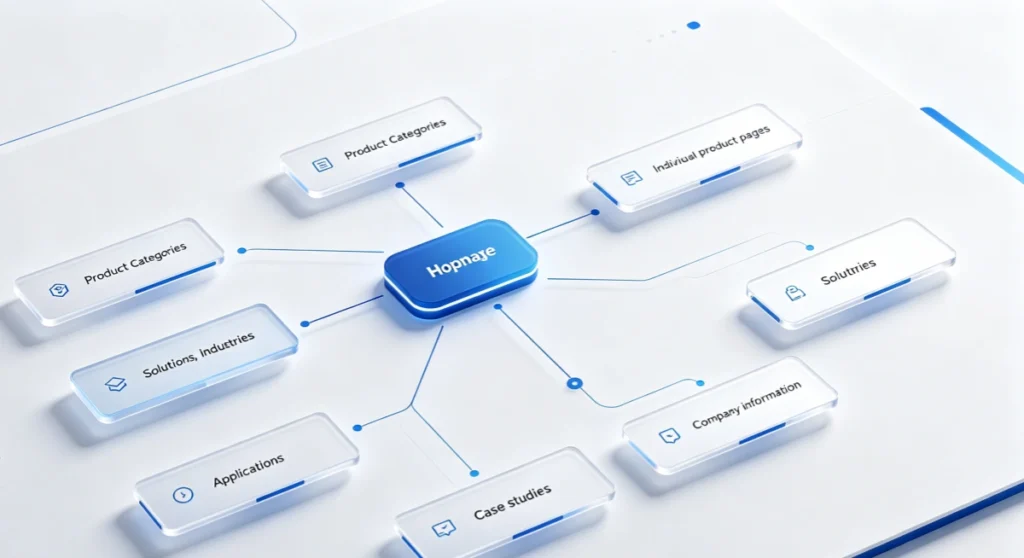
For many manufacturers and exporters, a practical website structure could look like this: Homepage as the main entry point, followed by Product Categories and Individual Product Pages for product discovery; Industries and Solutions for application-based navigation; Case Studies and About Us for trust; Manufacturing and Certifications for supplier evaluation; Resources and FAQ for information and SEO; and Contact or Request a Quote for conversion.
This structure can be expanded over time as the company adds new products, enters new markets, develops new solutions, or builds a larger content library.
Final Thoughts
A successful B2B manufacturing website is not defined by how many pages it has. It is defined by whether those pages help the right buyers find the information they need and move toward a purchasing decision.
At a minimum, most manufacturers should consider building dedicated pages for their company, product categories, individual products, industries, solutions, case studies, manufacturing capabilities, certifications, resources, FAQs, and contact or quotation requests.
When these pages are connected through a thoughtful B2B website structure, they can support more than website navigation. They can become the foundation for B2B SEO, Google Ads landing pages, content marketing, AI Search Optimization, and long-term international lead generation.
The best manufacturing website is not the one with the most pages. It is the one that answers the buyer’s questions at the right moment and makes it easy for them to take the next step.