

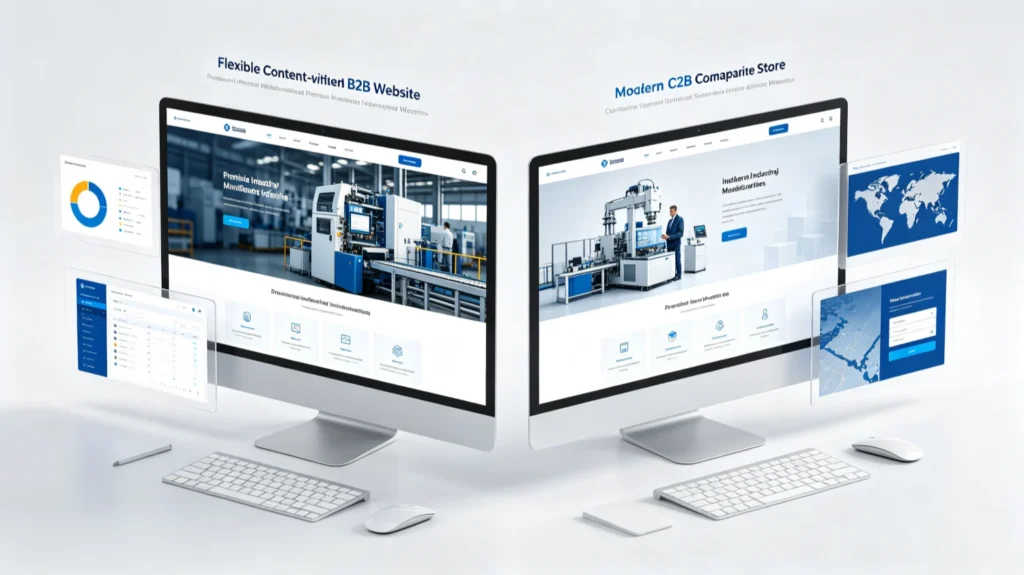
WordPress vs Shopify: What’s the Main Difference?
The simplest way to understand the difference is to look at what each platform is designed to do best.
Shopify is primarily an eCommerce platform. It provides many of the tools required to build and operate an online store, including product management, shopping carts, checkout, payment integrations, order management, and inventory-related functions. If your business sells standardized products directly online, Shopify can be a convenient option.
WordPress, particularly when combined with WooCommerce where needed, is a more flexible content management system. It can be used to build anything from a simple corporate website to a large B2B website with hundreds of product pages, industry solutions, technical resources, case studies, landing pages, and lead generation tools.
This distinction matters for manufacturers because many B2B companies do not actually sell products through an online checkout. Instead, customers visit the website to research products, compare suppliers, review specifications, and submit an inquiry or request a quotation.
When the primary goal is generating qualified inquiries rather than processing online transactions, the flexibility of the platform becomes much more important.
Which Is Better for a B2B Manufacturing Website?
For most manufacturers and exporters, WordPress for B2B is often the more flexible choice. This is especially true when the website is designed primarily for international lead generation rather than direct online sales.
A typical manufacturing company may have dozens or hundreds of products, multiple product categories, different industries, technical applications, certifications, project cases, and customized solutions. The website may also need landing pages for different markets and content designed to attract buyers at different stages of the purchasing process.
WordPress makes it easier to create this kind of content-driven website. You can structure the website around products, industries, applications, solutions, case studies, and resources instead of forcing everything into a traditional online store structure.
Shopify can certainly be customized for B2B use, but it is generally more natural for businesses whose website revolves around products, shopping, and transactions.
If your customers typically click “Add to Cart” and complete a purchase online, Shopify may be a strong option. If they usually click “Request a Quote,” “Send an Inquiry,” or “Talk to an Expert,” WordPress is often a better fit.
WordPress vs Shopify for B2B SEO
SEO is one of the biggest factors to consider when choosing a platform for an international B2B website. Manufacturers often depend on Google to attract buyers who are actively searching for specific products, suppliers, and technical solutions.
Both WordPress and Shopify can be optimized for SEO, so it would be inaccurate to say that one platform automatically ranks better than the other. Search rankings depend on many factors, including content quality, website architecture, technical SEO, backlinks, search intent, page experience, and authority.
However, WordPress SEO generally provides more flexibility. You have greater control over page structures, content types, internal linking, metadata, URLs, schema markup, blog content, landing pages, and other elements of the website.
This becomes particularly valuable when building a large B2B content strategy. A manufacturer may want separate pages for product categories, individual products, industries, applications, technical guides, comparison articles, procurement questions, and case studies.
WordPress is particularly strong for this type of content-driven SEO strategy because content is one of the platform’s core strengths.
Which Platform Is Better for B2B Lead Generation?
For most B2B manufacturers, lead generation is more important than eCommerce functionality. A website visitor may not be ready to purchase immediately. Instead, they may want to request a catalog, ask about customization, discuss specifications, or obtain a quotation.
This makes the website’s conversion structure extremely important.
A well-designed B2B lead generation website can provide different conversion paths depending on the visitor’s intent. Product pages can include “Request a Quote” buttons, technical articles can encourage visitors to contact an expert, and industry pages can direct potential customers toward relevant solutions.
WordPress gives you considerable freedom to design these conversion paths. Forms, landing pages, pop-ups, CRM integrations, WhatsApp, downloadable resources, and custom lead qualification workflows can all be integrated into the website.
Shopify also supports lead generation, but its core experience is still centered around eCommerce. For a manufacturer that does not use online checkout, many of Shopify’s native features may simply not be necessary.
Product Pages: WordPress vs Shopify
Both platforms can create professional product pages, but the way you structure those pages can be quite different.
A Shopify product page is naturally designed around selling a product. It works particularly well when customers need to choose a variant, select a quantity, add the product to a cart, and complete an online purchase.
A manufacturing company may need something much more detailed. A typical B2B product page may need to include technical specifications, materials, dimensions, production capabilities, customization options, applications, certifications, downloadable documents, related products, project examples, and frequently asked questions.
There may also be no fixed price because the final quotation depends on specifications, order volume, customization, destination, or project requirements.
In this situation, a product page should function more like a technical sales page than a traditional online store page. WordPress gives you greater freedom to create this type of customized product experience.
Which Is More Flexible for Custom B2B Website Design?
Manufacturers often have requirements that do not fit neatly into a standard website template. You may want a customized product catalog, industry-specific navigation, technical resource center, project database, distributor portal, quotation workflow, or multilingual website.
This is where WordPress has a significant advantage.
Because WordPress is highly extensible, developers can create custom post types, custom fields, templates, taxonomies, integrations, and content structures based on the company’s actual requirements. This allows the website to evolve as the business grows.
Shopify also offers extensive customization, particularly through themes, apps, APIs, and Shopify development. However, some custom B2B requirements may require additional apps, development work, or workarounds within Shopify’s eCommerce-oriented structure.
For companies that want a highly customized B2B website design rather than a traditional online store, WordPress usually offers more freedom.
WordPress vs Shopify for International B2B Marketing
International B2B marketing usually involves more than simply listing products. Your website may need to target different countries, industries, applications, and search intents.
For example, an industrial manufacturer might create content around specific products while also developing pages such as “Filtration Solutions for Chemical Processing,” “Industrial Filtration for Water Treatment,” or “Custom Filtration Systems for OEM Applications.”
This type of content architecture can support both SEO and lead generation because it allows the company to speak directly to different customer requirements.
WordPress is particularly suitable for this approach because it allows the website to function as both a corporate website and a content marketing platform. You can build product pages, solution pages, industry pages, case studies, guides, comparison articles, and other resources within one flexible system.
Shopify can support content marketing as well, but its primary strength remains eCommerce. If your international marketing strategy depends heavily on content and organic search, WordPress may provide a more natural foundation.
WordPress vs Shopify for AI Search and GEO
Another consideration for modern B2B companies is how their website performs in AI-powered search experiences.
Potential buyers are increasingly using AI tools to research manufacturers, suppliers, products, and solutions. Instead of searching for individual websites one by one, they may ask an AI system to explain a technical problem, compare suppliers, or recommend companies that meet specific requirements.
This makes AI Search Optimization, also known as Generative Engine Optimization (GEO), increasingly relevant to B2B marketing.
Neither WordPress nor Shopify automatically guarantees visibility in AI search. What matters is the quality, structure, authority, and consistency of the information available about your company.
However, WordPress provides strong flexibility for building the type of content ecosystem that supports GEO. Companies can publish detailed product information, expert articles, FAQs, case studies, technical guides, original research, and industry insights while maintaining a structured website architecture.
For manufacturers that want to build long-term authority in both Google search and AI search, this flexibility can be valuable.
Which Platform Is Easier to Manage?
When it comes to basic website management, Shopify is generally easier for beginners. Hosting, security, core platform updates, and many eCommerce functions are handled within the Shopify environment. This reduces the amount of technical maintenance required from the business owner.
WordPress requires more responsibility. Depending on your setup, you may need to manage hosting, WordPress updates, plugins, security, backups, performance, and other technical components.
However, this additional responsibility comes with greater control. A professionally managed WordPress B2B website can be optimized specifically for performance, SEO, security, content management, and lead generation.
For companies without an internal technical team, the solution is not necessarily to avoid WordPress. Working with an experienced WordPress development partner can provide the flexibility of WordPress without requiring the internal team to handle every technical task.
Which Is More Cost-Effective for B2B Manufacturers?
The cost comparison between WordPress and Shopify is not as simple as comparing subscription prices.
Shopify typically operates on a subscription model, and additional costs may come from premium themes, apps, payment processing, development, and other services. WordPress itself is open-source, but you need to consider hosting, premium plugins, development, maintenance, security, and other services.
The more important question is what you actually need from the website.
If your company needs a straightforward online store with standardized products and online payments, Shopify can be cost-effective because many eCommerce functions are already built into the platform.
If your company needs a customized B2B website focused on SEO, content marketing, product discovery, lead generation, and international customer acquisition, WordPress may provide better long-term value because you are not paying primarily for eCommerce features you may never use.
When Should a B2B Manufacturer Choose Shopify?
Shopify can be an excellent choice when your business model is primarily eCommerce-driven. If customers can easily understand your products, see fixed prices, select options, add products to a cart, and complete transactions online, Shopify’s strengths become much more relevant.
It can also be a good choice if your company already has an established eCommerce operation and wants a platform that simplifies store management, checkout, inventory-related workflows, and online transactions.
For manufacturers selling standardized products directly to consumers, distributors, or smaller business customers, Shopify may provide everything you need without the complexity of a more customized website.
When Should a B2B Manufacturer Choose WordPress?
WordPress for B2B is particularly attractive when the website’s main purpose is international lead generation rather than direct online sales.
If your products require customization, pricing depends on specifications, customers need technical information, or your sales process usually starts with an inquiry, WordPress gives you the flexibility to build the website around that process.
It is also a strong option when SEO and content marketing are central to your growth strategy. A manufacturer can build a large content ecosystem around products, industries, applications, technical questions, comparisons, case studies, and procurement topics.
For companies planning to combine B2B website design, Google SEO, Google Ads, AI Search Optimization, and other digital marketing channels, WordPress can serve as a flexible central platform for the entire marketing system.
WordPress vs Shopify: A Simple Comparison
There is no single platform that is best for every business. The right choice depends on your business model and what you expect your website to accomplish.
For a B2B manufacturer, WordPress is generally stronger when the priority is flexibility, content, SEO, customized product pages, lead generation, and long-term international marketing. Shopify is generally stronger when the priority is eCommerce, online checkout, product transactions, and simplified store management.
If your customers typically ask for a quotation before buying, WordPress is likely to be the better starting point. If customers can purchase standardized products directly online, Shopify deserves serious consideration.
Final Thoughts
Choosing between WordPress vs Shopify is ultimately a question of business strategy rather than simply website technology.
For many B2B manufacturers and exporters, the website is not an online shop. It is a digital sales tool that needs to attract international buyers, explain complex products, demonstrate credibility, generate inquiries, and support the sales team throughout a longer purchasing process.
In that situation, WordPress offers a high level of flexibility for building a customized B2B website around products, industries, applications, content, SEO, and lead generation. Shopify remains a strong platform for companies whose business model is primarily based on eCommerce and online transactions.
The best platform is therefore the one that matches your sales process. Before choosing a CMS, ask a simple question: Do we need a website that sells products online, or a website that helps our sales team generate and convert B2B leads?
For most manufacturers with a complex sales process and an international lead generation strategy, that distinction can make the decision much clearer.