
Choosing the right multilingual SEO solution can make or break your international B2B expansion strategy. One of the most common questions we hear from manufacturers, industrial suppliers, and B2B exporters is: “Do I need GTranslate Business or Enterprise for my multi-language website?”
After helping dozens of industrial companies go global, we’ve discovered that many website owners misunderstand what each plan actually delivers—especially when it comes to language-specific domains and SEO performance.
In this comprehensive guide, we’ll break down the real differences between GTranslate Business and Enterprise, debunk common myths about multilingual SEO, and help you choose the right plan for your B2B business.
What GTranslate Business Can (and Cannot) Do
Let’s start with a clear, honest reality check: Business does NOT support Language Hosting, which means you cannot achieve independent country-code top-level domains (ccTLDs) like example.de or example.fr with this plan.
However, that doesn’t mean Business is insufficient for most B2B companies. Here’s what you actually get:
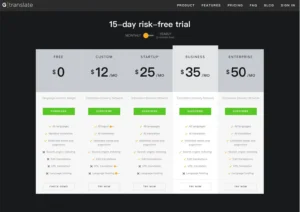
Business Plan ($35/month) – Core Capabilities
| Feature | Supported? | Details |
|---|---|---|
| Multi-language translation | ✅ | 100+ languages available |
| Google indexing of translated pages | ✅ | Search engines crawl all language versions |
| SEO-friendly URLs | ✅ | Translated keywords appear in URLs |
| Subdirectory structure | ✅ | /de/, /fr/, /es/ formats |
| Independent domains or subdomains | ❌ | Not supported |
| Language Hosting service | ❌ | Not included |
Subdirectory Structure: What Business Delivers
With the Business plan, your multilingual website uses a subdirectory structure:
URL Examples
| Language | URL Format |
|---|---|
| English (default) | example.com/vacuum-pump/ |
| German | example.com/de/vakuumpumpe/ |
| French | example.com/fr/pompe-a-vide/ |
| Spanish | example.com/es/bomba-de-vacio/ |
What This Means for SEO
✅ Each language version has a unique, independent URL
✅ Translated page content is fully indexable by Google
✅ Keywords are translated in URLs (e.g., vacuum-pump → vakuumpumpe)
✅ Hreflang tags can be implemented for language targeting
✅ Each language version can rank independently in its respective market
The bottom line: For 90% of B2B manufacturers and industrial companies, this structure is more than sufficient for global SEO success.
What Enterprise Delivers – The Language Hosting Advantage
The Enterprise plan ($50/month) adds one critical feature: Language Hosting. This enables:
Option 1: Country-Code Top-Level Domains (ccTLDs)
| Country | Domain |
|---|---|
| Germany | example.de |
| France | example.fr |
| Japan | example.jp |
| Spain | example.es |
Option 2: Subdomains
| Language | URL |
|---|---|
| German | de.example.com |
| French | fr.example.com |
| Spanish | es.example.com |
How Language Hosting Works
GTranslate’s Enterprise plan handles the technical complexity behind the scenes:
-
DNS configuration – Maps each language domain to your main site
-
Site mapping – Associates language versions with their respective domains
-
Translation cache management – Maintains performance across domains
-
Search engine language relationships – Configures proper hreflang and language signals
The SEO Myth Debunked: Does example.de Outperform example.com/de/?
Many business owners believe that owning example.de automatically gives them an SEO advantage over using example.com/de/.
The reality: Google evaluates many more factors than just the domain extension.
What Google Actually Cares About
| Ranking Factor | Impact |
|---|---|
| Content quality | High – Native-quality translations matter most |
| Localization depth | High – Local currency, addresses, phone numbers |
| Backlinks | High – Local backlinks signal regional authority |
| User experience | High – Loading speed, mobile optimization |
| hreflang tags | Medium – Signals language/region targeting |
| Domain extension | Low – A minor signal, not a ranking guarantee |
Real-World Example
A German industrial machinery website with:
-
Domain:
example.com/de/vakuumpumpe/ -
Native-quality German content
-
German customer testimonials
-
Local backlinks from German industry blogs
-
German phone number and contact information
…will outperform a poorly localized example.de site every time.
Which Plan Should You Choose? Decision Guide
Choose Business ($35/month) If:
✅ You’re a manufacturer, industrial supplier, or B2B exporter
✅ You want to reach multiple international markets with one domain
✅ You prioritize cost-effectiveness and simplicity
✅ You’re targeting German, French, Spanish, or other major European markets
✅ You don’t have separate local teams or entities in each country
Best for: Vacuum pump manufacturers, machine tool suppliers, packaging equipment companies, and industrial component exporters.
Recommended Structure
example.com
 ├── /de/     → German market
 ├── /fr/     → French market
 ├── /es/     → Spanish market
 └── /it/     → Italian market
This structure delivers excellent SEO results at a fraction of the cost of managing multiple domains.
Choose Enterprise ($50/month) If:
✅ You’re building a global brand with local presence
✅ You have separate legal entities or sales teams in each country
✅ You run country-specific advertising campaigns (Google Ads, local directories)
✅ You need complete separation of language domains for operational reasons
✅ You plan to invest heavily in local content marketing and link building
Best for: Enterprise-level B2B brands with dedicated in-country marketing teams and budgets.
Quick Comparison Table
| Consideration | Business ($35/mo) | Enterprise ($50/mo) |
|---|---|---|
| Monthly cost | $35 | $50 |
| URL structure | /de/, /fr/ |
.de, .fr or de.example.com |
| SEO indexability | ✅ | ✅ |
| Keyword translation in URLs | ✅ | ✅ |
| hreflang support | ✅ | ✅ |
| Independent domain management | ❌ | ✅ |
| Best for | Most B2B exporters | Global brands with local teams |
Final Recommendation
For most industrial B2B websites—whether you’re selling vacuum pumps, machine tool covers, packaging equipment, or other capital goods—the GTranslate Business plan with subdirectory structure offers the best balance of SEO performance and cost efficiency.
The /de/ and /fr/ subdirectory approach has helped countless B2B manufacturers achieve:
-
Top 10 Google rankings in Germany, France, and Spain
-
Increased organic traffic from international markets
-
More qualified leads and sales inquiries from Europe
Only upgrade to Enterprise if you have a specific business requirement for separate country-code domains—not because you believe it will magically boost your rankings.
Need help setting up multilingual SEO for your B2B website? Our team specializes in helping manufacturers and industrial companies optimize their international web presence. Contact us to learn more →